
Dog Tooth, a Greek film directed by Yorgos Lanthimos in 2009, achieved international success with its groundbreaking portrayal of family dimensions and political implications. Through the film, Lanthimos explores a patriarchal family to reflect the familial and international political state of the Greek society. One of the major discussions around the film is the totalitarian regime that parents impose on their still heavily protected adult children, and the way that the females in the family are subordinated by or surrendering to patriarchal control. The film highlights the older daughter’s discovery of the outside world and her attempt to break out of the sheltering of the family. However, the females are not the only victims in the film. The son’s experience shows another form of damage that the patriarchal totalitarianism causes, which is the failure of implementing its own gender role for the male.
In Dogtooth, the son is troubled by the deceptive information given by his parents through the myth of the “missing brother”. While the older daughter takes the thunder at the end of the film with her attempt of removing the dog tooth and going outside the house, the son’s rebel against the parental governing is mostly shown through his engagement with his missing brother that supposedly ran outside of the house and died in the hostile outside world. One of the most memorable scenes of the son is when the son stands in front of the fence talking to his “lost brother” outside after washing the car. From the conversation of the parents watching this event, the audiences are told that the son does this a lot. The scene first displays the son standing in front of a gigantic wall with bushes, his back facing the audience. Beyond the wall is the mountain with more trees and more barriers. Compared to the wall, he seems small and powerless. “I wish you’d see that I wash it [the car] better than you”, he confronts his missing brother beyond the wall, “You’d have cried if you’d seen that.” How the missing brother is doing outside the wall is a myth in the family, but the son assumes and believes that the brother does the same family duties that he does, and that cleanliness also matters to him. Therefore, the purpose of the missing brother must be to reflect on the suppressed inner psyche of the son. Every time the children ask questions, the parents offer made-up answers to prevent them from questioning the constructive, deceptive world within the house. The son’s connection to the missing brother suggests the son’s unrealized connection to the outside world, which he starts to question through the bicker with his brother.
In order to keep the children away from any influence outside their control, the parents imposes upon them that the constructed answer that the danger lurks in the outside world and that the household is a safe space. The missing brother serves as the son’s alternate self who lives in danger. The bodily self of the son is very much kept within the scope of the household. Even though the son is responsible for washing the only tool that allows people to go outside the house, he does not feel the urgency to go to the outside world. He associates the outside world with his missing brother who makes all the mistakes he does not make. “We are all very sorry that you failed to exterminate the cat…like I did. We are going to miss you… even though you made many mistakes.”, the son says to his dead brother during the funeral. In the family, the son plays the role of the good child who tries to live up to his parents’ expectations. He gets the most stickers out of all his siblings. He does not do any violent acts that we know of despite both sisters having incidents in the film where they physically hurt him, because grandpa’s singing tells him that the family members love each other. When the two daughters complain about how they have to share the same bedrooms with their new siblings, the son plays the piano in the background, not causing troubles for the parents. However, the son is often punished by the parents for talking to his missing brother. The behavior is hindering him from his role as a good son.

(the children singing along to their “grandfather” ‘s recording of “Fly Me To The Moon”)
The car washing scene ended up the same way that it started, with the son standing against the gigantic wall, but this time aggressively throwing rocks at it. Even though the son views the missing brother as an opposition, it would not be accurate to say that the missing brother is his internal enemy. Instead the missing brother symbolizes something that the son fears, there is a sense of anxiety-provoking uncertainty. By convention, uncertainty arises because of the lack of knowledge, in this case knowledge of the outside world. In the book This Tongue Is Not My Own, Ben Tyrer suggests that in Dog Tooth, the paternal metaphor provides structure for the Subject. However, he also writes that sometimes the father does not sufficiently establish a symbolic structure for the subject (in this case the son), and so according to Jacques Lacan’s theory which he quotes in the book, “phobia arises as a means of dealing with the anxiety that is felt when the name of the father does not sufficiently establish a symbolic structure for the Subject; it transforms this anxiety in to the fear of a specific object”. In other words, the Subject whose cognition is shaped by a symbolic structure would generate anxiety if the symbolic structure do not explain enough of the Subject’s reality, and that anxiety would be transferred to a fear of an object that would otherwise not contain such symbolism. In this case the object is the missing brother, whom, because of his absence, is further translated into the wall that supposedly contains the missing brother from the other side. Cognitively and symbolically, the missing brother connects and introduces the son to the outside world which he lacks knowledge of. Through the story of the missing brother, the son knows that the outside world is dangerous. However on a symbolic level, the son would feel that there is someone beyond the wall that is connected to him. The son’s body is contained inside the household, but he is also physically present in the larger society’s geography. He tries the hardest to live up to the flawed, made-up world that the parents created. The fearful throwing of the rock is therefore stimulated from the anxiety that the parents’ regime does not quite add up. This behavior is the son seeking for something that can justify the inconsistencies through the attempt to stimulate actions from the outside world. Christina, the only person from the outside world that the children are in contact with whom turned out to be a threat to the parental regime tells the son that she dreams about him as a zombie, that she and the father are throwing rocks at him but cannot quite get to him. The son does not know what the word “zombie” means, but Christina’s statement serves a symbolic purpose to make connections between the perfectionist son inside the wall and the rotten son in the outside world.

(the son standing against the fence talking to his brother on the other side)
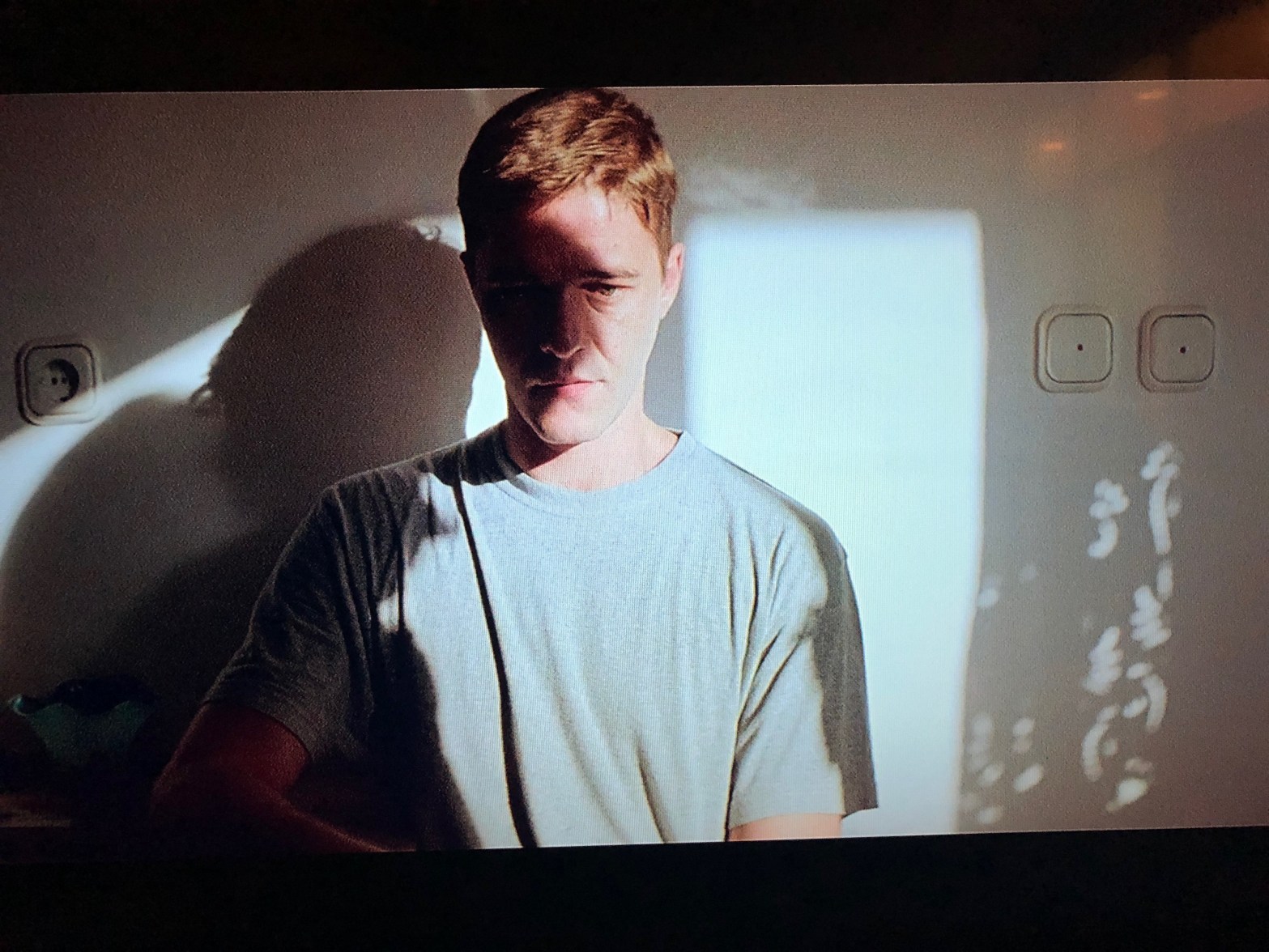
Despite the son’s attempt, he will not be ready to be the dominant male that he is expected to be in the patriarchal system. Because the son lives in the father’s totalitarian dominance, it should be no surprise that he would struggle to find his own dominance. In the film, the adult son is treated like the female family members: following the same rules, not allowed outside of the house, and competing with his sisters for resources. In fact, the presentation of the son is feminized by Lanthimos. For one thing, the son is obeying the rules of the parents throughout the whole film, even when having sex. In Greek cinema, masculine dominance is strongly contrasted with the feminine passivity which the son possesses. Throughout the film, the son is often portrayed in soft, natural sunlight while the appearances of the father are accompanied by harsh indoor lighting. At the dinner table, the son also asks the father to get him black tint for his brows because he is only left with blue tint which would be “unnatural”, suggesting that the son engages in the behavior of wearing makeup, which is normally associated with female behavior in the real society. For a supposedly male-dominated “society” inside the household, the son is just as unprepared for the outside world as his sisters. He is also told that he is ready to leave the house once his dog tooth falls out which would in fact never happen organically, so he is basically trapped in the house forever just like his sisters and mother. The parents do not prepare him to face the outside world. Technically, they give him some power to make choices within the family. In one scene, he is given the right to choose the family’s entertainment for the night because he has the most stickers amongst his siblings. But no one really knows if the parents intentionally favor the son or if he really deserves the most stickers. The parents might intend to raise him as a dominant figure among the siblings, but in the enclosed household he is not able to assert much dominance. Even the constructed dominance, the stickers, have the dual purpose of the parents’ means of making the children behave. In the language of the film, and in the culture that surrounds the language of the film, masculinity is associated with dominance; therefore, the feminine portrayal of the son emphasizes his powerlessness despite the parents’ attempts to attribute him with male-associated significance in the family, thus revealing the limitations of the totalitarian regime in not being able to sustain its patriarchal idea through the male offspring.

(father facilitating the son’s sexual life)
Throughout the film, the parents have no intentions in pulling the son out of the faulty narrative that they constructed. This makes sense in the short run family picture since the brother has become so close to the daughters that the three children could easily annul the paternal rule if they gain independence. But in the long run, the core of the regime – patriarchy – does not stand because of the lack of a strong male successor. Marios Psaras mentions Homi Bhabha’s argument of double time of the nation in the book The Queer Greek Weird Wave which is a way of connecting Dog Tooth with the current political state of Greece. According the the theory, there is the Real time of the world, and the time of Greece that traces backwards into its past. Greece as a country is founded upon ancient myths (the father), and the myths are still controlling Greece and hindering its future (the son). In December the year before film’s release, Greece is engaged in economic crisis and anti-foundational, anti-authoritarian political uprising which many analysts called “a crisis of meaning” fueled by “identity crisis, a nihilist outburst, or a collective psychodrama”. Greece’s politics is problematic because it lives on myths of its past and controlled by a corrupt, socialist government that shelters them from the outside world and tells them to love Greece’s fantastic past. The Greek ancient myths, fueled with nationalism, constructs its own symbolic order practiced by the government. The son in Dog Tooth symbolizes the under-supported young generation, the incapacitated future of Greece that is dissatisfied about its present but has no vision for an alternative solution, that can only imagine its alternative that takes risks without being held by the past. The strongly present parents attempt to dissociate the citizens of the household (the children) from the real time of the world outside of it. As a result, the inside of the household cannot quite sustain itself with the lack of presence of the outside world which the children need for healthy development. Some film theorists deny that the film is directly addressing the contemporary politics in Greece. But the contemporary Greece is still a valid model for considering a society strictly controlled by a corrupt government in any era.

(father training the children and mother to bark like dogs as defense to the outside world after their brother “is killed by a cat” there)
The myth of the missing son in Dog Tooth is a political allegory of the future of Greece in despair resulted from the glorification of its past and the construction of a national narrative. Anxiously sheltered, the son carries with him some form of inarticulable displease that he is being sent to the passive journey of life carved out by the parents. The film leaves us to consider the dangerous effects of a constructed narrative that is still nonetheless somewhat common in our real world society.
Work Cited:
Psaras, Marios. The Queer Greek Weird Wave: Ethics, Politics and the Crisis of Meaning. Palgrave Macmillan, 2016
Tyrer, Ben. “This Tongue Is Not My Own: Dogtooth, Phobia and the Paternal Metaphor.”
 Holly Cao